Google Photos On iPhone vs Android — What’s Actually Different?
Google Photos is basically the same app on both platforms — backup, search, and sharing work identically. But the integration with the operating system and the speed of new feature rollouts are not the same. Android, especially Pixel, gets AI editing tools first.
On Pixel, Google Photos is the camera roll. On iPhone, it sits alongside Apple Photos. Both work — but the Pixel experience is more seamless day to day.
Magic Eraser, Photo Unblur, and other AI editing features typically land on Pixel months before iPhone. By 2026 iPhone has mostly caught up — but Pixel still leads at launch.
If you’re an iPhone user, Google Photos is still an excellent backup layer. You don’t need to switch platforms to benefit — just don’t expect quite the same native feel. Want the tightest integration? A vetted refurbished Pixel is the safer bet.
Want the best Google Photos experience? Browse our vetted refurbished Pixel phones.
See Refurbished Pixels →- What Is Google Photos and Why Does It Matter on a Refurbished Phone?
- Is Google Photos Different on iPhone Than on Android?
- Which Has the Better Google Photos Experience: Pixel or iPhone?
- Do Editing and Special AI Features Work the Same on Both Platforms?
- Refurbished Phones for Google Photos, By User Type
- Google Photos Benefits – What Makes It So Good
- Getting Started With Google Photos
- Navigating Around Google Photos App
- Google Photos Memories
- How To Change What Shows Up In Google Memories
- How To Create Movies, Animations & Collages In Google Photos
- Google Photos: How To Create Animated GIFs
- Google Photos: How To Turn Your Photos Into A Collage
- Google Photos: Create A Slideshow
- Google Photo Albums
- How To Create Your Own Albums
- Google Lens
- Google Photos Storage & Space
- How To Digitise Old Photos
- How To Add Partner Account To Google Photos
- Keeping Google Photos Account Secure
What Is Google Photos and Why Does It Matter on a Refurbished Phone?
Google Photos is a free cloud storage and organisation app for your pictures and videos. Instead of clogging up your phone’s internal storage, everything gets backed up to Google’s servers, so you can access your entire photo library from any device with your Google account signed in.
That matters more than people think when you’re buying refurbished. A used phone’s storage is fixed. You can’t upgrade it later. Google Photos gets around that problem by moving the bulk of your photo library off the device entirely, which is one reason it’s worth setting up on day one with any of our best refurbished phones.
The app is available on every modern smartphone. That includes every refurbished iPhone from the iPhone 11 onwards, every Android phone running a reasonably current version of Android, and obviously the whole Pixel range. You download it free from the App Store or Google Play, sign in with a Gmail account, and it starts backing things up in the background.
Is Google Photos Different on iPhone Than on Android?
Yes, though not in the ways most people expect. The core features (backup, search, sharing, albums) work the same on both. What changes is how deeply the app plugs into the phone’s operating system, and how quickly new features show up.
Integration with the Operating System
On Android, Google Photos tends to fit more naturally into the phone’s photo workflow. That’s not surprising since Android is Google’s own platform, so the two are built to work together. On a refurbished Google Pixel 9 or Pixel 8, Google Photos can even sit alongside or replace the default gallery app entirely.
On iPhone, Google Photos works as a separate app that runs next to Apple Photos and iCloud Photos. It’s not a criticism of the app itself, just a fact of the ecosystem. You end up thinking a bit more carefully about which service is actually handling backup, and which one you delete originals from once they’re safely synced.
Background Backup Behaviour
Some iPhone users find background backup slightly less convenient than on Android. iOS is generally stricter about what apps can do in the background to save battery, so Google Photos may need the app open occasionally to catch up on a big backlog, especially after a fresh restore on a newly refurbished handset.
Feature Rollout Timing
New features and redesigns don’t always land on both platforms at once. One OS can get a visual refresh or a new tool a few weeks or months before the other. Historically that’s meant Android first, iPhone shortly after, though the gap has narrowed a lot over the past year.
Tech Tip
If you’re switching from iPhone to a refurbished Pixel, turn on Google Photos backup a day or two before you migrate. Once it’s finished, “free up space” will clear the originals off your old phone automatically, so the transfer to your new device is much faster.
Which Has the Better Google Photos Experience: Pixel or iPhone?
Pixel phones generally offer the stronger Google Photos experience because Google builds the software and the hardware together. Camera integration, AI search, and new editing tools land on Pixel first. iPhone still gets a genuinely good experience, just with a slight lag on the newest features and less system-level integration.
Day to day, if you’re mostly using Google Photos to view, search, and back up your library, you honestly won’t notice much difference. Where it becomes obvious is with the AI-driven tools, which is where Pixel has historically had the edge.
Do Editing and Special AI Features Work the Same on Both Platforms?
Mostly, yes, though Android and Pixel have usually had first access to Google Photos’ more advanced editing tools. Features like Magic Eraser, Photo Unblur, and Portrait Light appeared on Android before iPhone. iPhone has caught up on most of these, however, including conversational “help me edit” style tools.
What’s the Same
Basic edits, crop, filters, brightness, and colour adjustments work identically on both platforms. Search by face, location, or object also behaves the same way, since that processing happens in the cloud rather than on the device itself.
What Still Differs
Some users report small workflow quirks on iPhone, like how shared album edits sync or how multi-select actions behave compared with Android. None of it is a dealbreaker. It’s the kind of thing you’d only notice if you use both phones regularly.
Refurbished Phones for Google Photos, By User Type
Whichever platform you land on, buying refurbished shouldn’t mean settling for last year’s leftovers. Here’s how the current line-up breaks down depending on what you actually want out of your phone.
| User Type | Recommended Pick |
|---|---|
| Best overall / most buyers | Refurbished iPhone 15, 256GB |
| Best Google Photos integration | Refurbished Google Pixel 9 |
| Budget Android pick | Refurbished Pixel 8 or Pixel 8a |
| Samsung flagship | Refurbished Galaxy S24 Ultra |
| Foldable fans | Refurbished Galaxy Z Fold6 or Z Flip6 |
Did You Know?
Google Photos launched back in 2015 as a standalone app separate from Google Drive. That’s still true today, which is why it has its own storage rules and its own app, rather than living inside Drive with your documents.
Google Photos Benefits – What Makes It So Good
Unlike Apple, Google is focussed on making its services available to all. It doesn’t care if you use an iPhone or an Android phone, it wants to make its products – Gmail, Drive, Google Photos – accessible and useful to all types of users.
For this reason, Google Photos is preferable to Apple’s iCloud and Photos app because, should you decide to switch to an Android phone, you will be able to take all of your photos with you. It doesn’t work going the other way though, sadly, as Apple’s Photos is only available on iPhone.
This, as well as the following additional benefits below, is why Google Photos is so popular with hundreds of millions of users around the globe.
The way we see it, these are the main benefits of using Google Photos on Android and iPhone:
- Google Photos comes with unlimited storage. Thanks, Google!
- Google Photos uses AI and machine learning to organise and manage your photos.
- Google Photos works on ALL devices, including Apple products and Smart TVs – it’s completely cross-platform.
- Google Photos is incredibly easy to use
- Finding photos in Google Photos is really easy; you can search by name, location, or, thanks to its built-in machine learning, search by a face. Photos will build up a database of peoples’ faces overtime.
- Google Lens is built into Google Photos, so you can use it to get information about objects in your photos or even translate text.
These are our current favourite features and reasons why you should use Google Photos over Apple’s decent but still inferior Photos app.
Additional Resources
Getting Started With Google Photos
Google Photos is available for both Android and iPhone, unlike Apple’s Photos. To download Google Photos just follow the steps below:
- Go to either Apple’s App Store or Google Play and search for Google Photos
- Tap the icon and download Google Photos
- You’ll now need to sign in with a Gmail account. Don’t have one? You can get one here.
- Once signed in, follow the on-screen prompts to start backing-up your photos. This can take awhile, so be patient. Once they’re backed up, you’ll be able to go through them based on time, date, and via names and people’s faces
Now that all of your photos and videos are backed-up to Google Photos, you’re free to start exploring them. Google will automatically organise them based on times and dates, so they’ll be laid out in an easy to understand manner.
And because this is all done in the cloud, your Google Photos – and the order they’re listed in – will remain the same, regardless of what device you view them on, be it your phone, your tablet, or your PC and/or laptop.
Navigating Around Google Photos App
Google is great at designing simple-to-use applications. This the #1 reason why Gmail is so damn popular; it make email less of a headache.
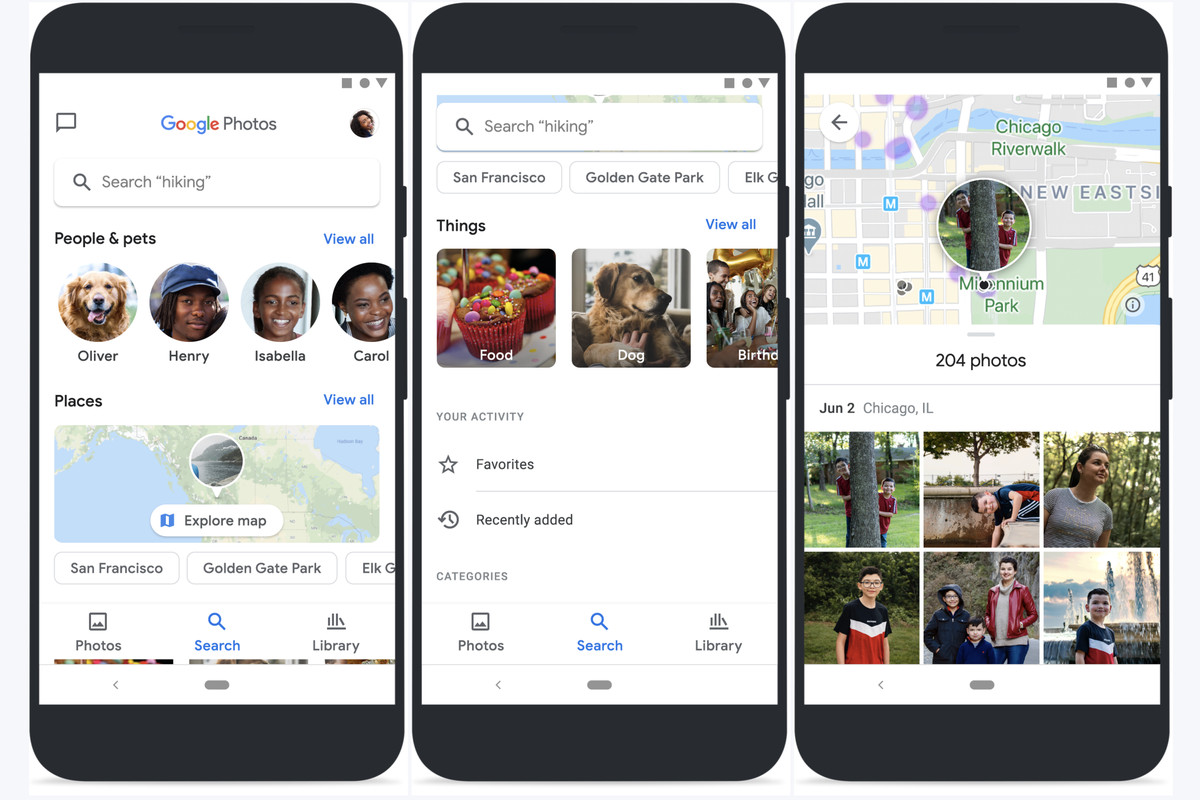
With Google Photos, you have three main navigation icons to work with: Photos, Search, and Library – these cover all the main bits of Google Photos and they allow you to interact with and view any photo or video stored in the app with a single click.
Let’s explore each navigation component in more detail.
- Photos – in this tab, you’ll find all your most recent photos as well as Memories that are listed across the top. With Memories, Google will pull in photos and videos from specific dates (1 year ago, or 3 years ago), so you can look back relive what you were doing on that day. This feature is really cool and very popular with users.
- Search – In Search, you can quickly locate and find specific photos and videos using either person (face or name), category, map, or things. For instance, if you went on holiday to Thailand, you could simply type “Thailand” and Google Photos will pull in all your content taken in that location.
- Library – Inside Library in Google Photos, you’ll find all your Albums, Favorites, Archives, and Trash. This is also where you can quickly create movies, collages, and animations using Library’s Utilities feature (more on that in a bit though).
If you want to look at a photo individually in Google Photos, simply tap it and it will expand to full screen. From here, at the button of the image, you’ll see options for Share, Edit, Google Lens, and Delete.
- Edit – If you want to tweak the image, add a filter, or make changes (cropping or color balance edits) then this is what you use to do it.
- Google Lens – Lens is Google’s AI-powered inspection tool. You can use Google Lens to pull information about a photo or anything in the photo. For instance, you could use Lens to translate the words on a sign in your picture.
In the top right corner, you’ll see options for Cast, Favorite, and More.
- Favorite – Clicking this icon saves the photo or video to your Google Photo’s Favorite album.
- More – If you need to add a photo to an album, archive it, delete it, or edit a photo or video’s information, you’ll find options for these in More.
Additional Resources
Google Photos Memories
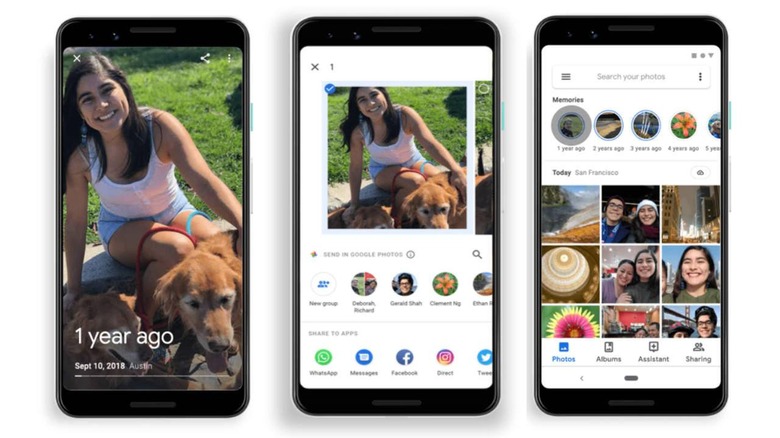
Back in 2019, Google stumbled across a massively popular trend in one of its updates to Google Photos: our collective never-ending love and thirst for nostalgia.
Memories are collections of photos and videos, based on specific dates in the past, that are accessible only to you. Memories is available on Google Photos for iPhone, iPad and Android but it not yet available on the desktop version of Google Photos.
With Google Photo’s Memories feature, Google’s AI pulls in your best photos and videos from a past date – it could be from 12 months ago or 5 years ago – and populates them at the top of your Google Photos app.
As soon as you open Google Photos, you’ll see Memories – they sit right at the top of the app’s main page.
If you tap on a specific Memories folder, Google will play a collage of all the images and videos contained in that Memories file. It is a truly brilliant feature, especially if you have young kids.
I’ve spent hours re-watching stuff from when my oldest, now three, was a baby, watching him grow and change and develop.
How To Change What Shows Up In Google Memories
Memories is a brilliant feature of Google Photos. But what if you have Memories you don’t want to be reminded about? Google has a fix for this, and it is really simple to implement, giving you more choice over what shows up in the Memories carousal.
- Tap your account profile photo – it’s located in the top right corner.
- Next, select PHOTO SETTINGS > MEMORIES
- Inside the next section, you can select certain people, pets, dates, and places you don’t want to show up in Memories.
Additional Resources
How To Create Movies, Animations & Collages In Google Photos
Most people, if you’re anything like me, take gazillions of photos and videos. You go to lunch, you snap a picture. Your wife goes into labour, you document the entire thing from start to finish.
In Google Photo it is really easy to quickly find all of these images and videos using things like its search features – dates, faces, locations.
But for really special events, your first child being born, a birthday party, or a road trip and/or holiday, why not push the boat out and make a full on movie, collage or animation?
Google Photos makes is REALLY simple to do all of these things. And the best part is that Google’s machine learning does it all for you – all you have to do is select the photos and videos and it’ll do the rest.
Here’s how you make movies, collages and animations in Google Photos:
- Tap Library > Utilities
- At the bottom, you’ll see options for Animation, Collage and Movie
- Select the one you want to make and follow the prompts
Let’s say you want to create a movie. You go to Library > Utilities > Movies. Next, Google will ask you to choose some photos and videos (you can use up to 50). After that, you’ll need to choose some music.
Google Photos also has specific options for things like cat videos, dog videos, and videos for kids growing up. These are templates, so use them if you have something specific in mind.
Or, if you’d prefer, just use the blank New Movie option, select some music and a theme, and let Google crunch all the photos and videos together into a movie.
It doesn’t take long at all and the results are always really pretty impressive. Through a combination of filters, edits, pans, and zooming, Google Photos creates epic-looking movies that you can easily share with friends, family and loved ones.
Once your movie is complete, you can either save it, publish it to YouTube, add it to Google Drive, or share it with contacts on your phone. It’s all really simple and it is one of Google Photo’s best features, as it requires ZERO editing skills or knowledge.
Google’s software does all the heavy-lifting and you get a stunning movie without lifting a finger.
Google Photos: How To Create Animated GIFs
One of the coolest hidden features of Google Photos is the ability to turn your pictures into animated GIF images. To do this is really easy and straightforward:
- On the Create Animation screen that pops up, choose between 2 and 50 photos you want to turn into a single GIF.
Google Photos: How To Turn Your Photos Into A Collage

Google Photos also gives you the ability to merge multiple pictures into a single collage. This will join them all together in a single image. It’s quite a cool tool as you can then use this single image of multiple photos and share it to social media sites like Instagram. To create a collage:
- On the Create Collage screen that pops up, choose between 2 and 9 photos you want to turn into a collage.
Google Photos: Create A Slideshow
Another out of the way–but an extremely useful feature – of Google Photos is the ability to turn any Google Photos folder or album into a slideshow. It’s deceptively simple how easy it is to do this, which is why so many people look right over it. To create a slideshow in Google Photos:
- The slideshow will automatically begin playing on your screen. Use the toolbar in the lower left-hand corner to pause it or skip forwards or backwards in the slideshow.
Google Photo Albums
Part of the reason Google Photos is so useful is its organisation know-how; it uses complex algorithms to understand context, locations, and time to group together images and videos in a meaningful manner, so you don’t have to worry about a thing.
For instance, say you took a weekend break in the Rome. You snap a load of pictures and videos. Google Photos will know that you’re on holiday, based on the location, and automatically group these photos together in an album called “Holiday In Rome” for instance.

Again, you DO NOT have to do anything: Google will group all of the images together into an Album automatically.
This makes finding holiday snaps, pictures from events, and videos from important and/or significant events really simple. To view all your current Albums, simply go to Library > Albums – you will see all of your current Albums save here.
How To Create Your Own Albums
Having stuff done for you is great. But what if you want to create your own Albums inside Google Photos? Once again, The Big G has your back and has thought of every eventuality. Creating your own, custom albums in Google Photos is simple. Here’s how it is done:
- Open Google Photos.
- Find the photos and videos you want to add to an album and select them by pressing down on them.
- Select all the images you want to add to the new album.
- Click Add To > Album
- Then all you have to do is give your album a name
Once your custom Google Photos Album is created, you can share it with anyone you like. The album will also be accessible with all your other non-custom albums inside the app too.
Additional Resources
Google Lens
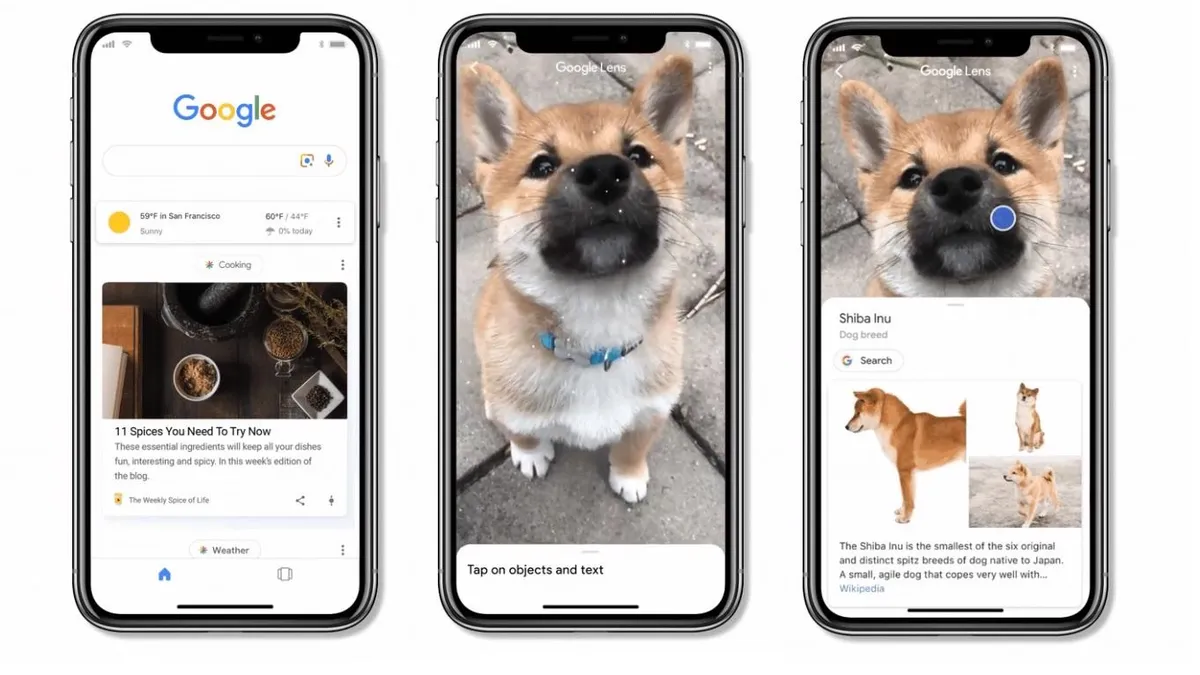
To the uninitiated, Google Lens kind of feels a little bit supernatural, as it can essentially view and image inside Google Photos and pull up all kinds of information from the picture for you.
Say you have a picture of a dog that you snapped and you want to find out what breed it is. Open the picture of the dog and tap Google Lens. Google’s bonkers AI will then view the image and present you with a raft of information about the breed of dog in the picture.
Or, say there’s a document or book you have a picture of but the language isn’t one you understand. Click Google Lens and it will translate the text for you. This also works for signs and anything with text inside your photos.
Alternatively, you can use Google Lens to copy and text, so you could use Google Lens to take a scan of a page from a book and then copy and paste the text into a Google Doc or WhatsApp.
Here’s a quick overview of all the things you can do with Google Lens:
- Auto: Provides search results based on the image it sees.
- Translate: Translation on top of the original words.
- Text: Point Lens at the text you want to copy. You can even copy text from paper to your laptop.
- Shopping: Point Lens at an item that you would like to find in a store or scan the barcode.
Google Photos Storage & Space
Is Google Photos free? Yes, the app itself is 100% free and you do get unlimited uploads with no storage limits. But there are caveats that you need to be aware of, namely compression. For instance:
Google compresses all images to 16MP resolution and all videos to 1080p. This is what is referred to as “unlimited high quality” storage. And for most people, this will be all you ever need.
You can opt to save your images and videos in their full resolution but this will take up space in your allocated free 15GB of Google Drive storage.
All Gmail accounts comes with 15GB of free storage. This covers Gmail, Google Drive, and Google Photos.
If you use Google Photo’s standard settings, it won’t eat into your 15GB, as the images will be compressed per Google’s wishes.
If you don’t want your images compressed, you will probably want to opt for more storage. Fortunately, additional cloud storage is NOT expensive. I pay $2.99 p/m for 100GB which gives me plenty of wriggle room for keeping full-res photos and videos in Google Photos.
Need more Google Photos storage? Here’s how you get it:
- Open Google Photos
- Go to Photo Settings > Backup & Sync > Buy Storage
If you don’t want to have to buy more storage, it is worth checking that your Google Photos account is saving your images in “high quality” as this will give you unlimited storage space (with images compressed to 16MP and video to 1080p).
Here’s how to check what quality your Google Photos and Images are being saved in:
- Tap your Profile in Google Photos
- Photo Settings > Settings > Backup & Sync
- Select “High Quality” – or, if you don’t mind getting extra storage, “Original Quality”
Additional Resources
How To Digitise Old Photos
Nearly every family has a huge cache of old photos, sometimes dating back fifty or more years. You could have your grandparent’s old photo album or your parent’s collection of your baby pictures. Either way, Google Photos has a really cool feature that lets you digitise them.
This is a brilliant feature because it keeps precious family albums and photos safe online. Things can happen, bad things, that result in irreplaceable photos and family albums being lost. By digitising them, you effectively ensure their survival for evermore.
If you want to start digitising your old photos and save them to Google Photos, here’s how you do it:
Once you’ve scanned all your old photos, you can then quickly back them up to Google Photos for posterity.
How To Add Partner Account To Google Photos
If you have a partner or family member that you’re ALWAYS sharing images and videos with, you can simply just add them to your Google Photos account.
This means, rather than having to send them images all the time, they simply get access to certain folders and albums inside your Google Photos account.
For instance, I take LOADS of pictures of my kids. I like to share them with my mum and dad. I use Google Photos, so I just added them and gave them access to a specific Album – one of pictures of my kids – so they can pop in and view new uploads whenever they like.
Of course, to do this the other person will need to have a Google account – meaning a Gmail. If they have Gmail, you can given them access to certain albums, images from a specific date, select photos, or even a specific person. Here’s how to set it up:
- Open Google Photos
- Go To Settings > Partner Sharing > Get Started
Once this is set up, the other person – your mum, dad, cousin, brother, or spouse – will have access to whatever files or albums you specified. If you want to stop them having access, simply go back through the steps above and remove the permission.
It really couldn’t be easier.
Additional Resources
Keeping Google Photos Account Secure
Google Photos – and your phone, in general – is fairly secure. Google and Apple spends billions of dollars a year to make their platforms as secure as possible from hackers and scammers.
But nothing is ever 100% secure. Things happen. People click on dodgy links in spam emails. And this can result in your phone – as well as its contents, including Google Photos – being accessed of hijacked by a hacker.
This isn’t something that happens very often, in fact, given the sheer number of phones in operation today, it is very unlikely to happen to you. But it is always good to prepare for the worst, just in case.
As a general rule of thumb, you should have some kind of protection enabled on your phone – either a pin code, a face unlock, or a fingerprint for accessing it. If you don’t have any of these in place, stop what you’re doing right now and sort it out.
The reason you’ll want to do this is because, in the event your phone is lost or stolen, the person that ends up in possession of your phone cannot access it. Without biometric or password-based protection, they’ll be able to open your phone and do what they like.
If you’re worried about any of this, it is probably worth setting up Google’s 2-Step Verification on your phone. Here’s how Google describes it and how you go about setting it up – just follow the steps and your Google Account will be locked-down like Fort Knox.
Additional Resources
- Can Google Photos Be Hacked? + How To Protect Your Account
- How To Make Google Photos Private
- How To Delete Your Google & Gmail Account
Buying tools
Thinking About Buying an iPhone?
Compare current refurbished prices, see how it stacks up against alternatives, and avoid overpaying for the wrong model.
Recommended for this article