
Which US Mobile Network Should You Choose?
If you are happy with your current coverage, start with the US Mobile network that uses the same major carrier. It is the safest place to begin.
Choosing By Features Instead
Dark Star
The strongest feature-based choice. Unlimited Starter gets uncapped high-speed data and twice the hotspot allowance provided on Warp and Light Speed.
Warp
The better fit if Verizon coverage performs well locally or you need cellular service for a compatible smartwatch.
Light Speed
The travel pick and a strong option anywhere T-Mobile’s mid-band 5G network delivers good local coverage and speed.
US Mobile lets you move your line to another network without leaving the carrier or losing your phone number.
Start monthly and test the network at home, at work and along the routes you regularly use. Do not pay for a full year until you know the coverage works where you need it.
Choosing a US Mobile plan is only half the job.
You also need to decide which underlying network will carry your calls, texts and data.
US Mobile gives them its own names:
| US Mobile network | Network it uses |
|---|---|
| Warp | Verizon |
| Dark Star | AT&T |
| Light Speed | T-Mobile |
Top-rated refurbished phone deals right now
These are the refurbished phones we currently recommend the most.
- 01iPhone 16 Pro 512GB · Black TitaniumView deal →
- 02Samsung Galaxy Z Fold6 256GB · SilverView deal →
- 03Google Pixel 9 Pro XL 256GB · GrayView deal →
The plan price stays the same whichever network you select.
The service you receive does not.
Coverage, network priority, high-speed data, hotspot allowances, international roaming and smartwatch support can all change based on your choice.
So, which one should you pick?
- Warp is the best starting point if Verizon already works well in your area, you want higher-priority data on Unlimited Premium or you need cellular Apple Watch, Pixel Watch or selected Galaxy Watch support.
- Dark Star is best for heavy data and hotspot users. Unlimited Starter gets uncapped high-speed phone data, while Unlimited Premium includes US Mobile’s largest hotspot allowance.
- Light Speed is best for T-Mobile users, people in areas with strong T-Mobile 5G and frequent international travelers. It supports roaming in more than 180 countries, but every Light Speed plan uses standard network priority.
For many people, the best answer is even simpler: start with whichever major carrier already works reliably at your home, workplace and regular travel routes.
US Mobile lets you transfer between its three networks, so your first decision doesn’t need to be permanent.
US Mobile Networks Compared
| Feature | Warp | Dark Star | Light Speed |
|---|---|---|---|
| Underlying network | Verizon | AT&T | T-Mobile |
| 5G included | Yes | Yes | Yes |
| Starter high-speed data | 70GB | Uncapped | 70GB |
| Starter hotspot | 10GB | 20GB | 10GB |
| Premium phone data | Uncapped | Uncapped | Uncapped |
| Premium hotspot | 50GB | 100GB high-speed, then 100GB at 8Mbps | 50GB |
| Premium priority | High | High | Standard |
| Starter priority | Standard | Standard | Standard |
| International roaming reach | 125+ countries | 110+ countries | 180+ countries |
| Apple Watch support | Yes | No | No |
| Pixel Watch support | Yes | No | No |
| Galaxy Watch support | Selected models | No | No |
| Best for | Verizon coverage and wearables | Data and hotspot use | T-Mobile 5G and travel |
These differences matter most on Unlimited Starter and Unlimited Premium.
Unlimited Flex is more consistent across the three networks. It includes 10GB of high-speed phone data and 5GB of hotspot regardless of the network selected.
You can see how Flex, Starter, Premium, Light and By the Gig compare in our full US Mobile plans and prices guide.
What Is US Mobile Warp?
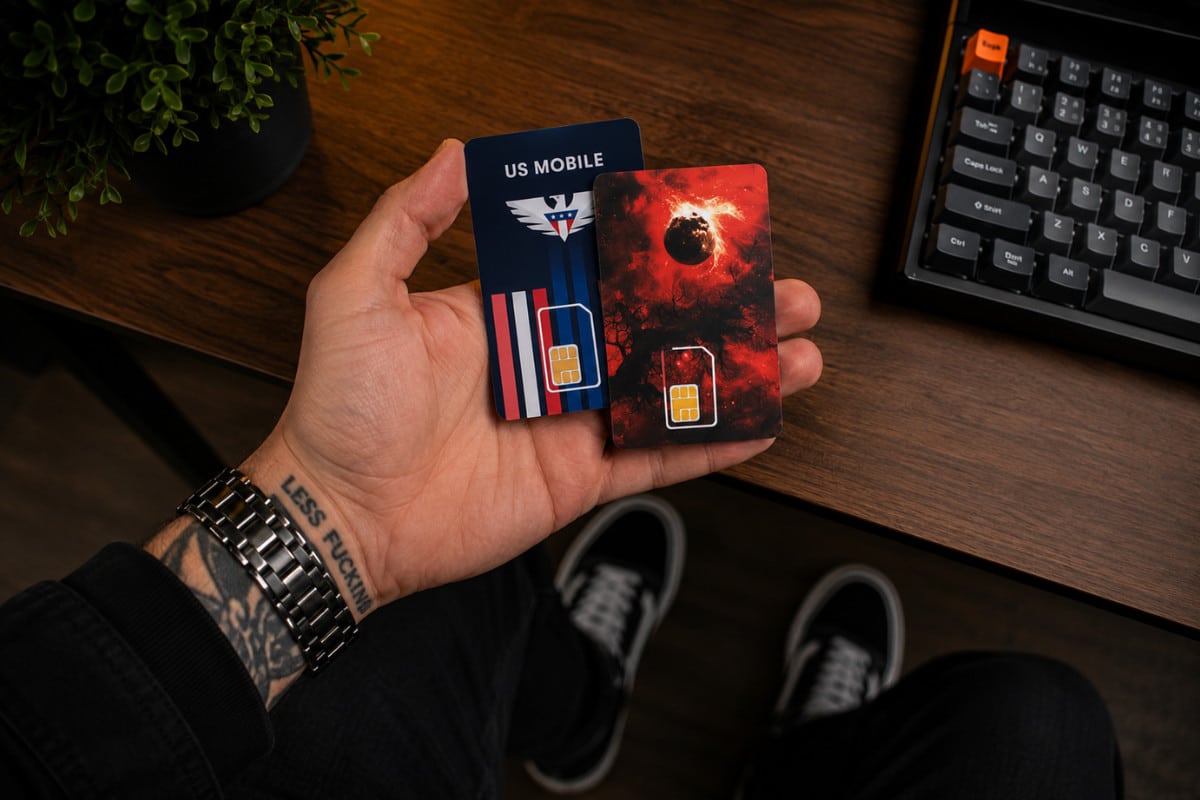
Warp uses Verizon’s network.
It provides access to Verizon’s 4G LTE, nationwide 5G and faster 5G Ultra Wideband coverage where supported by your phone and location.
If you currently use Verizon and are happy with its reception, Warp is the logical place to start. You should receive broadly similar geographic coverage because your phone is connecting to the same underlying network.
That does not mean a $25 US Mobile line is identical to a Verizon postpaid plan.
Billing, customer service, roaming, network priority, phone promotions and account features are handled by US Mobile. Your traffic may also receive different treatment when a Verizon tower becomes congested.
Warp data allowances
| US Mobile plan | High-speed phone data | Hotspot | Priority |
|---|---|---|---|
| Unlimited Flex | 10GB | 5GB | Standard |
| Unlimited Starter | 70GB | 10GB | Standard |
| Unlimited Premium | Uncapped | 50GB | High |
Once a Starter line uses 70GB, data continues at a reduced speed for the rest of the billing cycle. You can also purchase a high-speed data top-up.
Unlimited Premium doesn’t have that 70GB phone-data threshold. It also receives higher network priority.
What does Warp priority mean?
US Mobile’s current priority table places Warp Unlimited Premium at QCI 8, which it describes as high priority.
Starter, Flex and By the Gig use QCI 9, described by US Mobile as standard priority.
The number itself isn’t something most people need to worry about. What matters is what happens when the tower is busy.
Imagine you’re at a football stadium with 50,000 other people. A high-priority Premium line should be served before lower-priority traffic when the local network runs short of capacity.
A standard-priority Warp line may temporarily feel slower.
If the tower isn’t congested, both can be extremely fast. Paying for priority does not magically improve a weak signal, nor does it guarantee a particular download speed.
It mainly changes your position in the queue during busy periods.
Warp coverage
Warp is generally a strong choice for:
- Rural areas
- Smaller towns
- Highway travel
- Parts of the Northeast
- Anyone already happy with Verizon
- Buildings where Verizon penetrates better than T-Mobile
Local testing still matters.
A coverage map might show a solid block of red over your neighborhood, but it cannot tell you whether Verizon works properly in your kitchen or inside your office.
If you want to combine cheaper service with a cheaper device, our guide to the best refurbished Verizon phones covers the iPhones, Pixels and Samsung phones we’d buy.
Warp international roaming
Warp supports native roaming with calls, texts and data in more than 125 countries.
Unlimited Premium includes:
- Up to 20GB of roaming data
- 200 minutes
- 250 texts
Annual Unlimited Starter includes:
- 1GB of roaming data
- 200 minutes
- 250 texts
Roaming can be purchased separately on other eligible plans. US Mobile currently sells top-ups starting at $15.
Warp supports fewer roaming destinations than Light Speed, but more than Dark Star.
Before traveling, search for the specific destination in US Mobile’s international roaming checker. “125+ countries” is useful as a broad comparison, but it doesn’t confirm the allowance or local partner available in the one country you’re actually visiting.
Warp device and smartwatch support
Warp is the clear winner for wearables.
US Mobile currently supports the following on Warp:
- Apple Watch companion mode
- Apple Watch standalone mode
- Pixel Watch Series 2 and newer in companion mode
- Selected Samsung Galaxy Watch models in companion mode
Unlimited Premium customers on Warp receive an eligible companion smartwatch plan at no extra cost.
Apple Watch standalone mode gives the watch its own number. It can be used by a family member without an active US Mobile phone line, although an iPhone is still needed for setup.
Pixel Watch does not support standalone mode. It must be connected as a companion to a Pixel phone line.
Samsung support is more limited. At the time of writing, US Mobile lists the Galaxy Watch 9 and Galaxy Watch Ultra 2. The watch must be paired with an Android phone on Warp.
There is another small catch: 5G Apple Watches can be activated, but they currently connect through LTE rather than 5G.
Who should choose Warp?
Choose Warp if:
- Verizon already works well where you live
- Rural or highway coverage matters
- You own an Apple Watch
- You own a supported Pixel Watch or Galaxy Watch
- You want high-priority data with Unlimited Premium
- 50GB of Premium hotspot is sufficient
- You rarely exceed 70GB on Starter
Who should avoid Warp?
Consider another network if:
- Verizon is weak at your home or workplace
- You need more than 50GB of high-speed hotspot data
- You want uncapped Starter data
- You travel frequently to countries not supported by Warp
- AT&T or T-Mobile is clearly better in your area
Warp verdict: The safest option for existing Verizon users and easily the best US Mobile network for smartwatch owners.
What Is US Mobile Dark Star?
Dark Star uses AT&T’s network.
It is the strongest option for heavy smartphone data and hotspot use, especially when paired with Unlimited Starter or Unlimited Premium.
The big advantage is simple: Dark Star provides more data than Warp and Light Speed at the same plan price.
Dark Star data allowances
| US Mobile plan | High-speed phone data | Hotspot | Priority |
|---|---|---|---|
| Unlimited Flex | 10GB | 5GB | Standard, optional priority add-on |
| Unlimited Starter | Uncapped | 20GB | Standard |
| Unlimited Premium | Uncapped | 100GB high-speed, then 100GB at 8Mbps | High |
On Unlimited Starter, Dark Star provides uncapped high-speed smartphone data instead of the 70GB included with Warp and Light Speed.
The hotspot allowance also doubles from 10GB to 20GB.
Premium is even more generous:
- First 100GB of hotspot at high speed
- Next 100GB at up to 8Mbps
- Speeds reduced to around 600Kbps after 200GB
US Mobile calls this unlimited hotspot. It is unlimited in the sense that it does not stop at 100GB or 200GB. It is not unlimited maximum-speed hotspot.
That distinction gets lost remarkably quickly on carrier plan pages.
Dark Star data priority
Unlimited Premium runs at QCI 8, US Mobile’s high-priority level on Dark Star.
Starter runs at standard QCI 9.
Flex and By the Gig also use standard priority unless you purchase the optional priority-data add-on.
This makes Dark Star a little more flexible than Warp. You can add higher-priority data to certain cheaper plans instead of moving all the way to Unlimited Premium.
US Mobile does not currently list the priority add-on as an option for Starter, though. Starter remains standard priority even with its uncapped high-speed data.
That shows why “uncapped” and “priority” should not be treated as the same thing.
A Dark Star Starter line can continue using high-speed data without reaching a published 70GB threshold. It can still be placed behind Premium traffic when an AT&T tower becomes congested.
Dark Star coverage
Dark Star makes sense in areas where AT&T performs better than Verizon and T-Mobile.
That can include:
- Rural parts of the South and Midwest
- Suburban areas with established AT&T LTE coverage
- Buildings where AT&T has a stronger indoor signal
- Travel routes poorly served by T-Mobile
- Locations where Verizon towers become heavily congested
There is no universal winner.
Verizon might work brilliantly at your house and fail inside your workplace. AT&T might do the exact opposite.
This is why US Mobile’s network choice is more than a marketing gimmick. You can test Dark Star and move the line if it doesn’t work.
Dark Star international roaming
Dark Star supports native roaming in more than 110 countries.
That is the smallest destination list of the three networks. US Mobile also notes that around 30 Dark Star destinations are data-only.
You may need to select your destination through the US Mobile app before traveling. This additional setup is easy to miss if you assume roaming will simply switch itself on after landing.
Premium and annual Starter receive the same headline roaming allowances available on the other networks:
| Plan | Included roaming |
|---|---|
| Unlimited Premium | Up to 20GB, 200 minutes and 250 texts |
| Annual Unlimited Starter | 1GB, 200 minutes and 250 texts |
| Other eligible plans | Paid add-on |
Roaming add-ons are currently available from $15:
- $15 for 1GB, 150 minutes and 150 texts
- $30 for 5GB, 500 minutes and 500 texts
Destination support varies, so check the country before buying the plan.
Dark Star device support
Most modern unlocked US-market iPhones, Samsung Galaxy phones, Google Pixels and Motorola phones should work on Dark Star.
An AT&T-compatible phone is the safest option.
Imported Android phones need more care. They may be missing US cellular bands, VoLTE support or the correct carrier configuration even when the specifications appear close.
US Mobile’s general compatibility page says most unlocked devices made since 2013 are likely to work, provided they support 4G LTE and VoLTE. “Likely” is doing some work there.
Run the exact IMEI through the compatibility checker before transferring your main number.
Dark Star does not currently provide US Mobile’s cellular Apple Watch, Pixel Watch or Samsung Watch service. Those wearable plans use Warp.
Who should choose Dark Star?
Choose Dark Star if:
- AT&T has the best coverage in your area
- You regularly use more than 70GB
- You want 20GB of hotspot on Starter
- You need more than 50GB of hotspot on Premium
- You want the option to add priority to Flex or By the Gig
- Watch support does not matter
- Your destination is covered by Dark Star roaming
Who should avoid Dark Star?
Consider another network if:
- You need cellular smartwatch service
- Verizon or T-Mobile is stronger locally
- You want the largest international roaming list
- Your destination is one of Dark Star’s data-only countries
- You want high priority without buying Premium or an eligible add-on
Dark Star verdict: The best US Mobile network for heavy data and hotspot use. Starter on Dark Star is arguably the strongest value combination US Mobile sells.
What Is US Mobile Light Speed?
Light Speed uses T-Mobile’s network.
It is a good choice for fast 5G in cities and built-up areas, existing T-Mobile or Mint users and people who regularly travel internationally.
It also comes with the simplest priority rule: every Light Speed plan uses the same standard QCI 7 level.
Light Speed data allowances
| US Mobile plan | High-speed phone data | Hotspot | Priority |
|---|---|---|---|
| Unlimited Flex | 10GB | 5GB | Standard |
| Unlimited Starter | 70GB | 10GB | Standard |
| Unlimited Premium | Uncapped | 50GB | Standard |
Unlike Warp and Dark Star, Unlimited Premium does not move Light Speed customers to a higher priority level.
Premium still gives you uncapped high-speed phone data, 50GB of hotspot, international roaming and free network transfers. It just doesn’t improve your position during T-Mobile congestion.
That makes Premium less convincing on Light Speed if your only reason for upgrading is priority.
Is QCI 7 on Light Speed good?
QCI numbers cannot be compared directly across different carrier networks as though they share one universal ranking.
Light Speed QCI 7 does not automatically mean it is better than Warp QCI 8 or worse than Dark Star QCI 9. Each underlying carrier runs its own network-management system.
The useful takeaway is that all US Mobile Light Speed customers sit on its standard US Mobile priority tier.
During quiet periods, Light Speed can be extremely fast. T-Mobile has a large mid-band 5G network and often delivers excellent download speeds in cities and suburbs.
During congestion, though, US Mobile traffic may slow behind higher-priority T-Mobile customers.
Light Speed coverage
Light Speed is often a strong option for:
- Cities
- Suburbs
- Areas with T-Mobile Ultra Capacity 5G
- Existing Mint Mobile users
- Existing T-Mobile users happy with local reception
- People who place speed above remote rural coverage
Its weaker point can be rural and fringe coverage.
T-Mobile has expanded enormously, so the old claim that it “only works in cities” is outdated. It still may not match Verizon or AT&T on every remote road, farm or small community.
Once again, local testing wins.
Light Speed international roaming
This is Light Speed’s best feature.
It supports native roaming with calls, texts and data in more than 180 countries, beating Warp’s 125+ and Dark Star’s 110+.
That does not mean every plan includes free roaming.
Unlimited Premium receives up to 20GB of international data, 200 minutes and 250 texts. Annual Starter receives 1GB, 200 minutes and 250 texts. Other eligible plans need an add-on.
Light Speed users may also need to check or update their APN settings before roaming.
That is worth doing while you still have Wi-Fi at home, not after landing at an airport and discovering your data doesn’t work.
Light Speed device support
Most unlocked US-market phones supporting T-Mobile’s main LTE and 5G bands should work.
Light Speed can also be the easiest US Mobile option for certain imported or international Android phones because many support T-Mobile-compatible bands. That is not guaranteed.
Band 71 support is particularly useful for T-Mobile’s extended-range coverage. A phone without it may work well in a city yet lose service sooner as you travel into less populated areas.
Check the exact model number, not just the phone’s marketing name.
An American Galaxy S26 and an international Galaxy S26 may look identical while supporting different radio bands and carrier features.
Light Speed does not currently support US Mobile’s cellular smartwatch plans. Apple Watch, Pixel Watch and supported Galaxy Watch service runs through Warp.
Who should choose Light Speed?
Choose Light Speed if:
- T-Mobile works well in your area
- You live in a city or suburb with strong T-Mobile 5G
- You currently use Mint Mobile and like its coverage
- International destination support matters
- You do not need cellular smartwatch service
- 70GB of Starter data is enough
- 50GB of Premium hotspot is enough
Who should avoid Light Speed?
Consider another network if:
- T-Mobile performs poorly indoors locally
- You spend lots of time in remote rural areas
- Network priority during congestion matters
- You need more than 50GB of Premium hotspot
- You use more than 70GB and do not want Premium
- You want Apple Watch, Pixel Watch or Galaxy Watch service
Light Speed verdict: The best US Mobile network for international reach and people living in strong T-Mobile 5G areas. It is less attractive for rural users and anyone paying for Premium mainly to get priority data.
Which Network Has The Best Coverage?
There isn’t one answer that applies everywhere.
In broad terms:
- Warp usually makes the most sense for Verizon users and rural coverage
- Dark Star makes sense where AT&T has stronger indoor or regional coverage
- Light Speed is often quickest in strong T-Mobile 5G areas
But national coverage statistics can’t choose a network for your home.
The best network is the one that works:
- Inside your house
- At your workplace
- On your commute
- At your children’s school
- Along routes you drive regularly
- In the rural areas you visit
- At busy local venues
Ask people living nearby what they use, check coverage maps and test the service before committing to an annual plan.
Which Network Has The Best Data Priority?
On Unlimited Premium:
- Warp receives high priority
- Dark Star receives high priority
- Light Speed remains on standard priority
On Unlimited Starter:
- All three use standard priority
On Unlimited Flex:
- Warp and Light Speed use standard priority
- Dark Star uses standard priority but supports a paid priority add-on
For Premium customers concerned about congestion, Warp and Dark Star are the better choices.
For Starter customers, priority alone does not produce an obvious winner. Local network capacity will have a bigger effect.
A lightly loaded standard-priority T-Mobile tower can beat a congested high-priority Verizon connection. Priority only becomes one part of the result.
Which Network Has The Best Hotspot?
Dark Star wins comfortably.
Unlimited Starter hotspot
- Dark Star: 20GB
- Warp: 10GB
- Light Speed: 10GB
Unlimited Premium hotspot
- Dark Star: 100GB high-speed, another 100GB at 8Mbps, then 600Kbps
- Warp: 50GB
- Light Speed: 50GB
If you tether a laptop for work, travel frequently or use hotspot as an emergency home-internet backup, Dark Star provides the most room.
If you only occasionally connect an iPad or laptop, the 10GB included with Starter on Warp or Light Speed may be enough.
Which Network Is Best For International Travel?
Light Speed supports the largest number of countries:
- Light Speed: 180+ countries
- Warp: 125+ countries
- Dark Star: 110+ countries, with around 30 data-only destinations
However, the included allowance depends on your plan, not just the network.
Premium includes up to 20GB, 200 minutes and 250 texts. Annual Starter includes 1GB, 200 minutes and 250 texts.
Someone traveling once a year might be perfectly happy with Warp if their destination is covered. A frequent traveler visiting several countries will get more flexibility from Light Speed.
Which Network Is Best For Apple Watch, Pixel Watch And Galaxy Watch?
Warp. No contest.
US Mobile’s wearable service currently runs on Warp, including:
- Apple Watch companion service
- Apple Watch standalone service
- Pixel Watch Series 2 and newer
- Galaxy Watch 9
- Galaxy Watch Ultra 2
Unlimited Premium includes eligible companion watch service at no extra cost.
If your smartwatch needs its own cellular connection, select Warp or be prepared to maintain the watch with another carrier.
Can You Change Networks Later?
Yes.
US Mobile calls this a Network Transfer.
You can move a line between Warp, Dark Star and Light Speed through your account dashboard. US Mobile says the transfer normally takes around ten minutes.
Current plans include:
- First two network transfers free on Flex and Starter
- $2 per transfer after the first two
- Free transfers on Unlimited Premium
The first two means the first two for the line, not two free transfers every month.
Changing networks can also require a new eSIM or physical SIM configuration. Do it when you have Wi-Fi and enough time to fix any activation problem.
What Is US Mobile Multi-Network?
Multi-Network lets a compatible phone maintain additional US Mobile network lines instead of replacing one network with another.
For example, you could use:
- Dark Star as your primary line
- Warp as a second line
- Light Speed as a third line
Your phone can then use whichever active connection works best.
The add-on costs:
- $10 a month per additional network
- $90 a year, equivalent to $7.50 a month, with an annual plan
New customers can currently try it for two billing cycles at no charge.
There are catches:
- Your phone must support multiple SIMs
- Secondary lines share the main plan’s data allowance
- Secondary lines receive standard rather than Premium priority
- The add-on can erase some of the savings that brought you to US Mobile
- Managing several active SIMs is more complicated
- Constant dual-SIM use can increase battery drain
Most people don’t need it.
I’d start on one network, test it properly and transfer if necessary. Multi-Network makes sense for people who travel around the country, work in places with patchy service or genuinely need two carriers available on one phone.
The Things US Mobile Doesn’t Make Obvious Enough
The same plan is not the same service
A $25 Starter line receives:
- 70GB and 10GB hotspot on Warp
- Uncapped phone data and 20GB hotspot on Dark Star
- 70GB and 10GB hotspot on Light Speed
The price is identical. The allowances aren’t.
Premium doesn’t provide high priority everywhere
Warp and Dark Star Premium receive high priority.
Light Speed Premium remains standard priority.
If congestion performance is your main reason for paying $44, that matters.
Uncapped data can still be standard priority
Dark Star Starter has uncapped high-speed phone data, but it uses standard priority.
Your service doesn’t hit a published usage threshold, but it can still slow temporarily when AT&T’s network is busy.
The best network for data might not be the best for coverage
Dark Star offers the largest allowances. That means nothing if AT&T provides one bar at your house.
Coverage comes first. Included gigabytes come second.
Watch support can decide the entire question
If you want your smartwatch connected through US Mobile, you need Warp.
It is easy to activate a phone on Dark Star, then discover that the watch feature you wanted is only available through Verizon-powered Warp.
Roaming country counts don’t tell the whole story
Light Speed supports more than 180 countries, but your plan still decides how much data you receive.
Dark Star supports fewer destinations, and some are data-only.
Check the exact country, allowance and calling support before leaving.
Which US Mobile Network Should You Choose?
Pick Warp if:
You want Verizon coverage, rural reliability, high-priority Premium data or cellular smartwatch support.
Pick Dark Star if:
You want uncapped Starter data, the largest hotspot allowance or AT&T works best locally.
Pick Light Speed if:
You want T-Mobile coverage, fast urban 5G or the widest international roaming support.
My Recommendation
Start with the network used by your current carrier if you’re happy with its coverage:
- Verizon customers should start with Warp
- AT&T customers should start with Dark Star
- T-Mobile and Mint customers should start with Light Speed
If you’re choosing purely by features, Dark Star offers the most for your money. Unlimited Starter gets uncapped high-speed data and twice the hotspot allowance provided on Warp and Light Speed.
Warp is the better all-rounder if you need Verizon coverage or a cellular smartwatch.
Light Speed is the travel pick and a strong option anywhere T-Mobile’s mid-band 5G network performs well.
The nice bit is that choosing wrong isn’t a disaster. US Mobile lets you move the line to another network without leaving the carrier or losing your number.
Just don’t pay for a full year before testing it at home, at work and on the routes you actually use.
Check US Mobile’s latest plans and network options
For more low-cost carrier options, see our guide to the best US MVNO carriers and our breakdown of which carrier offers the most data for under $35 a month.
Keep reading
More useful guides from this section of KnowYourMobile.
