
Are Refurbished Pixel Phones Good Enough For Creators Now? Yep – Here’s Why…

Written by
✅ Get my weekly creator’s newsletter
Is It Time Creators Started Considering a Refurbished Google Pixel Phone?
Google’s Pixel phones have improved dramatically over the past few years and, thanks to the passage of time, you can now pick up refurbished Pixel phones with brilliant tech and performance for much, much less.
You can now pick up a refurbished Pixel 9 Pro XL for a fraction of its launch price, which makes it a legitimately interesting proposition for creators who want flagship AI camera tools without flagship spend.
But there’s a paradox here that hasn’t gone away: Pixel phones offer some of the best AI editing tools on the market, yet still fall short on the performance and workflow optimisations that serious creators depend on.
I’ve used nearly every Pixel to date. I like them. I love the software. But when it comes to video output and post-production pipelines, Apple is still ahead and that gap matters if content creation is how you earn money.
Here’s the full picture, updated for the Pixel 9 series.
Before we dig in, if you want a broader view of where Pixel sits against the competition, our roundup of the best refurbished phones is worth reading first.
Pixel 9 Series: What’s Available Refurbished Right Now
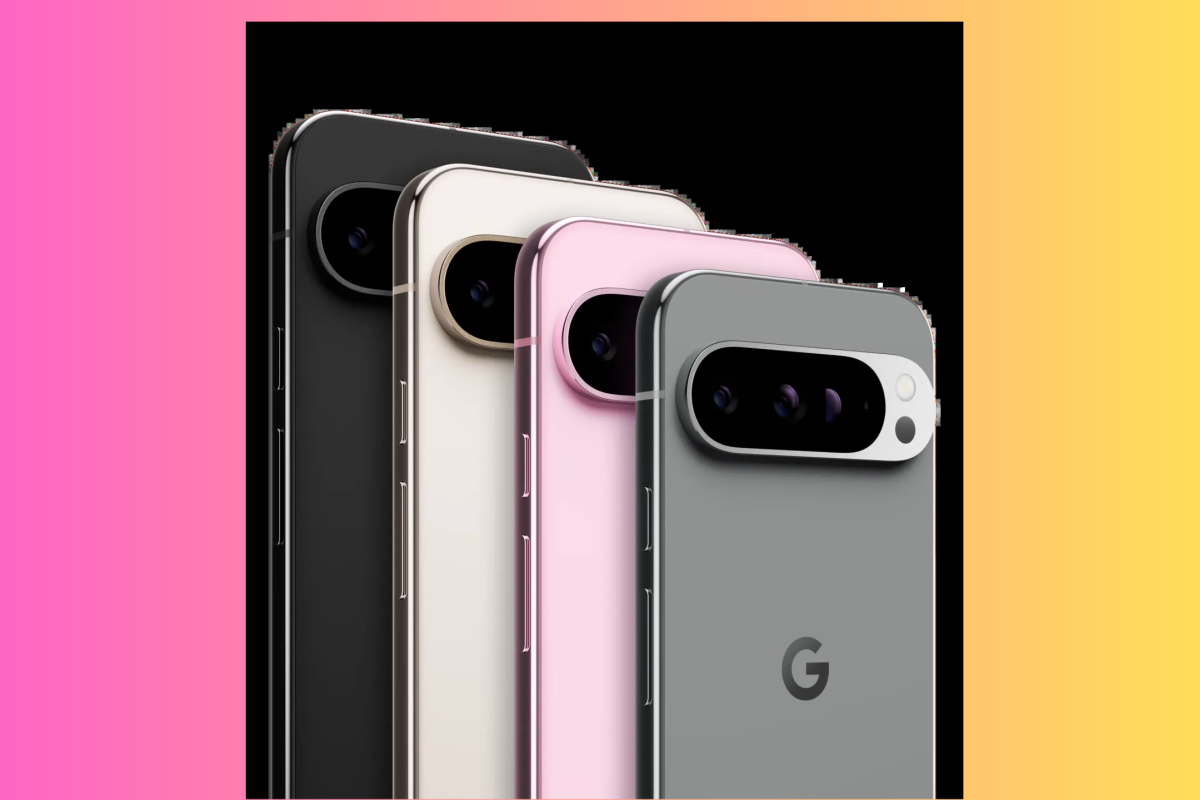
If you’re interested in using your next phone as a content creation tool, you’ll want to keep it locked to the Pixel 9 series. And in that series, there are three models you want to be looking at:
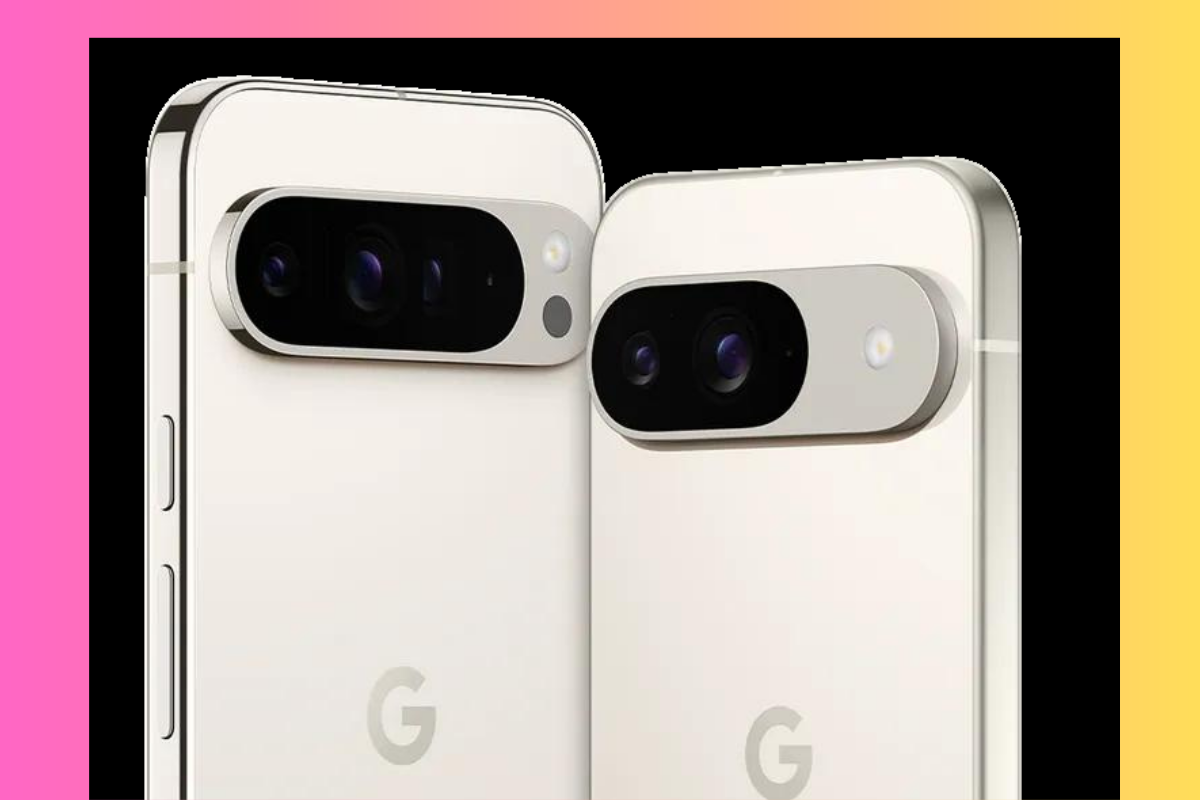
- Pixel 9 Pro XL — The flagship. Largest sensor, best low-light performance, most thermal headroom for sustained video recording. The version to get if budget allows. Available in 256GB Verizon Obsidian, 256GB Porcelain, 512GB Obsidian, and 256GB AT&T Obsidian.
- Pixel 9 Pro — Compact Pro tier with the same Tensor G4 chip and identical camera software. A smart pick if you prefer one-handed shooting.
- Pixel 9 — Entry-level of the 9 series, cheapest option of the three. Drops the telephoto lens and some Pro-exclusive AI features, but the computational photography core remains strong for still-focused creators.
For storage, 256GB is the sweet spot. You get enough headroom for 4K video projects without paying a premium for 512GB.
Where Pixel 9 Genuinely Excels For Creators
Still Photography & AI Editing Tools
The Pixel 9 Pro XL’s Tensor G4 chip is purpose-built for on-device machine learning, and it shows. Computational photography workflows that would take hours in desktop software happen in seconds:
- Magic Editor & Generative Fill — Move subjects in frame, relight scenes, replace skies, intelligently fill edges after cropping. It’s genuine time-saving for compositing work, not a gimmick.
- Best Take — Shoots a rapid burst and lets you swap individual faces from the sequence into a single composite. Essential for group shots and brand content.
- Night Sight — Still among the best low-light photography on any phone. Noise reduction, exposure balance, and texture retention are all excellent.
- Google Photos ecosystem — The best searchable photo library on mobile, with instant backup and AI-powered retrieval by abstract concept (“golden hour, beach, blue jacket”).
For TikTok and Instagram creators whose workflow is shoot → quick edit → upload, the Pixel 9 series is a genuine match for iPhone.
The point-shoot-upload speed is fast, and on-device AI handles edits that would otherwise require a laptop.
Still image quality on the Pixel 9 Pro XL is flagship-tier: wide dynamic range, accurate white balance, good noise control, and a 5x telephoto that delivers strong detail at native zoom.
The ultra-wide is also excellent. For still-first creators, this is genuinely competitive with the iPhone 15 Pro Max.
Where Pixel 9 Still Falls Short For Creators
Post-Production Workflow Limitations
Most serious creators don’t shoot and upload raw. You edit first — correct colour, add cutaways, fix pacing. On iPhone, this is a smooth pipeline: hand off to Mac, use iMovie or LumaFusion, done.
On Pixel (and Android broadly), it’s messier:
- No native video editing app — Google Photos’ video editor isn’t production-ready. You’re relying entirely on third-party apps.
- Tensor G4 and third-party app optimisation — The Tensor chip is brilliant at AI tasks and underperforms at sustained creative computing. Lightroom Mobile becomes sluggish with large RAW files. CapCut stutters during complex multi-track edits. Export times for demanding projects can run significantly longer than on equivalent iPhone hardware.
- Developer ecosystem — iOS gets better optimisation from creative app developers because the install base is larger and the hardware is more uniform. That’s just the reality.
Social Media Compression: The Problem That Won’t Die
Upload a 4K clip shot on a Pixel 9 Pro XL to TikTok or Instagram. Now do the same with identical footage from an iPhone 15 Pro. The iPhone version will look noticeably better — sharper, less noise, more natural colour.
This isn’t about the Pixel’s camera hardware. It’s about how TikTok and Instagram’s encoding pipelines handle Android vs iOS video.
They don’t treat them equally.
Android footage gets hit harder by compression artefacts, particularly in low-contrast areas and fine detail. Colours can shift toward over-saturation.
It’s a platform-level issue that Google has no control over, and it materially affects how your content looks to your audience.
For creators where this matters; and for video-first creators, it absolutely does — this is still a real disadvantage.
Video Boost Has A Catch
Pixel 9’s Video Boost is impressive in controlled conditions: it genuinely improves low-light video quality by offloading processing to Google’s servers.
But it’s not instant.
Your footage uploads to Google’s infrastructure, gets processed, then comes back to you. If you’re working to a posting schedule or need footage immediately, you’ll be waiting.
The 4K/60fps Reality
Pixel 9 can shoot 4K/60fps. In practice, colour grading that footage in post often requires a desktop correction pass — exposure can drift between shots, and colour can skew warm or cool in ways that look inconsistent across a sequence.
Which Pixel 9 Model Should Creators Buy Refurbished?
If you’re a still-first creator — photography, Instagram, AI art, composite work — a refurbished Pixel 9 Pro XL is an excellent and genuinely competitive choice.
The 128GB unlocked Pixel 9 Pro XL in Hazel or Porcelain gives you the full Pro AI toolkit at a price that undercuts Apple significantly.
If you’re a video-first creator — YouTube, TikTok, branded content, anything that involves post-production — the refurbished iPhone 15 Pro Max is still the smarter buy.
The workflow reliability, social platform compression advantage, and app ecosystem optimisation add up to a more consistent output, and consistency is what professional content creation requires.
You can browse our full range of refurbished Pixel 9 Pro XL models if you want to compare configurations and grading tiers before deciding.
For more buying guidance, our refurbished phone FAQ hub covers everything from grading standards to what warranty terms to look for.
Know Your Mobile Verdict
Pro Tip: The Pixel 9 Pro XL refurbished is one of the best value AI photography tools you can buy — and the price gap versus a new iPhone makes it tempting even for creators who ultimately prefer iOS.
If your content is primarily stills and short-form social, it’ll serve you well. But if video quality and workflow reliability are non-negotiable, don’t talk yourself into the Pixel to save money.
The refurbished iPhone 15 Pro Max gives you a proven, compression-friendly, ecosystem-optimised platform that will still be getting iOS updates for years — and iOS software longevity is a real advantage that compounds over time.
A word on hardware reliability: Google’s track record on long-term Pixel durability is patchy — display burn-in, battery degradation, and modem issues have all appeared in earlier generations.
Buying refurbished from a graded seller with a minimum 12-month warranty is the sensible way to manage that risk.
| Feature & Practical Use | Workflow Benefit for Creators |
| Magic Editor & Generative Fill | Time Saver for Composites: This goes beyond simple object removal. You can literally move your subject in the frame, change the color of the sky, or use the Auto Frame feature to rotate a crooked image and have the AI intelligently fill in the missing edges. It eliminates a tedious trip to desktop software like Photoshop. |
| Best Take (Group Shots) | Guaranteed Usable Photos: Never stress about group portraits again. The phone captures a rapid burst and lets you select the best expression for each person from the sequence, compositing them into a single, perfect image. |
| Google Photos Ecosystem | Ultimate Content Organization: Seamless, instant backup (at storage-saver quality for new devices) and the industry’s best search function. You can search your entire library by abstract concepts like “photos of a dog near a yellow flower,” instantly retrieving assets for a content brief. |
| Low-Light Stills | Flagship Quality, Budget Price: The Pixel’s Night Sight mode consistently captures outstanding low-light photos, often rivaling or exceeding competitors in its ability to balance exposure, texture, and noise, making it the best pocket camera for spontaneous night content. |
Are Pixel Phones Good For Video Content?
While Pixel’s still camera is stellar, you’ll start to see cracks in its armor when you start dealing with video and proper post-production workflows.
And for me, this is the real reason why Apple’s iPhone (the Pro and Pro Max, of course) are still the best option for most creators.
Most YouTube creators do not shoot on their phone and then upload straight to their channel.
Post-Production Issues Plague Pixel Users
You want to edit and tweak your content first, make it flow properly. Add in stuff you missed, correct mistakes.
On iPhone, this is simple.
You can quickly hand-off the process to your Mac and do it there or you can use on-device apps like iMovie or any of the other myriad video editing tools available for iPhone.
With Pixel phones (and Android phones, in general), it’s not quite as slick.
There is no native video editing tool available for Pixel, save for inside the Photos app (and that is NOT ready for the big leagues).
So, you have to use third-party apps as a workaround.
On iPhone, this is fine because Apple’s hardware is unified which means apps tend to run smoother and developers have fewer issues optimizing their apps for different models in the range.
This is why Lightroom runs so well on iPhone versus Android.
A LOT of people also use iPhone, whereas only a few (relatively speaking) are running Tensor-powered Pixel phones.
Do you think developers are going to spend resources optimizing their apps for phones that run Tensor? Spoiler: they ain’t.
Performance and App Optimization Lag
Case in point.
The custom Tensor chip, built for AI, frequently underperforms when running demanding third-party creative apps.
This is the single biggest workflow killer you’ll encounter when running Pixel phones as a creator:
- RAW File Editing is Slow: When importing and editing large 50-60MB RAW files from a dedicated camera, you’ll get significant lag. Sliders in Lightroom Mobile become unresponsive and export times can be up to five times slower than on a rival flagship.
- Mobile Video Editor Stuttering: Apps like Capcut are run poorly on Pixel with stuttering and overheating issues during complex edits which is a major pain in the bottom when you’re trying to be productive.
The Video Quality Gap & Social Media Uploads
Google has invested a lot of cash into the Pixel’s camera module. With still images, the quality has always been excellent. That’s been the case since day one.
But with video, Google has always struggled. In my experience, it still falls well behind both Apple and Samsung in this context.
On top of this, there’s other video-related issues that you simply cannot avoid if you’re using Android, which we’ll now cover below in more detail.
Social Media Compression Issues
If you’ve ever uploaded a Pixel video to TikTok or Instagram, you’ve probably seen how rough it can look after posting.
These platforms just don’t play nice with Android’s video system. The result is heavy compression, visible noise, and over-saturated colors.
It also was frustrating that apps like TikTok diminished my camera quality on Android. Comparing TikTok videos taken on an iPhone — even an older version like the iPhone X — with those taken on my Galaxy S10 Plus is like night and day.
On my Galaxy, TikTok distorted the colors and blurred everything in the most unflattering and unrealistic way. On the iPhone, videos are crisp and clear and appear just as they should. For someone who uses TikTok as much as I do, this was important.
Footage that looked crisp on your phone suddenly looks flat and grainy compared to the same clip uploaded from an iPhone.
4K/60fps Inconsistencies
Pixels can now shoot in 4K/60fps, which is great in theory, but once you export that footage, even through something simple like LumaFusion, you start seeing problems.
Colors often shift into over-saturated territory, and exposure levels can fluctuate between shots.
If you want your video to look right, you’ll probably need to run it through a proper color correction pass on your desktop.
Video Boost is Not Instant
Pixel’s cloud-based Video Boost is a clever feature that genuinely improves image quality, especially in low light.
But it comes with a catch: it’s not instant.
Your video has to upload to Google’s servers for processing before you get the final version back.
That means if you’re on a tight posting schedule or want to share footage immediately, you’ll be waiting longer than you’d like.
Should Buy A Pixel Phone For Content Creation?
| Primary Content Focus | Verdict |
| Still Photography, AI Art, and Organization | BUY THE PIXEL. Its unique AI tools and on-device photo editing capabilities offer an unbeatable, time-saving workflow for photographers and digital artists. |
| Professional Video, Fast-Paced Short-Form Content, and RAW Editing | KEEP THE IPHONE. Due to inconsistent video optimization on social platforms and significant performance lag in professional editing apps (Lightroom, Capcut), the iPhone still offers a more reliable and efficient workflow for video-first creators. |
Pixel phones are great phones nowadays and, in most cases, they can and do hold their own against similar devices from Apple and Samsung.
But from the perspective of a creator, Apple still has an advantage over Google. We’ve explored why in this post, highlighting the main areas where Google’s Pixel phones fall short.
A phone is an investment. They cost a lot of money.
If you’re going to use yours to create content for the purpose of making money with your creator business, you need to go with the most capable phone you can afford.
Right now, that’s an iPhone 17 Pro or iPhone 17 Pro Max or if you want to save yourself a ton of cash and get much the same level of performance, the iPhone 15 Pro Max or iPhone 16 Pro Max which is obviously more.
This isn’t a slight on Pixel phones or the people that use them; it’s just the way it is based on my own personal experience and the experience of other creators.