
Circular Tech, Refurbished Phones & You: The Complete Guide
·
Credentials
What Is Circular Tech & Why It Matters
Circular tech keeps devices in use for as long as possible — through repair, reuse, and refurbishment — rather than manufacturing, using, and discarding them. For smartphones, it’s the single most effective way to cut the environmental cost of staying connected. And buying refurbished is the easiest entry point.
Mining, chip fabrication, and global supply chains account for roughly 80% of a smartphone’s lifetime emissions. Charging it for three years is almost negligible by comparison.
Studies put the carbon saving at up to 87% less CO₂ than buying new. No new mining cycle, no new manufacturing run — just an existing device that’s been tested, graded, and put back to work.
The processor, storage, and logic board perform identically to day one. The battery degrades with charge cycles — which is why reputable sellers report battery health and replace cells below a threshold. Everything else is a non-issue.
Refurbished flagships like the iPhone 16 Pro or Galaxy S24 deliver identical performance at a significant discount. Extending your device lifecycle from 24 to 36 months cuts carbon footprint by around 40% and saves you real money at the same time.
Phones contain recoverable gold, silver, cobalt, and rare earths. When they go to landfill, that’s all lost. Trade-in and take-back schemes route devices back into refurbishment pipelines — the right move when you’re done with a handset.
Browse 680+ fully vetted refurbished phones — iPhone, Samsung, and Pixel.
See Refurbished Deals →What Is Circular Tech?
Every single person you know, save for your weird cousin that lives off-grid in the woods, uses a phone. Billions of people use them every single day, so if we could get even 3% of the phone-using population to switch to circular technology, in this case buying refurbished phones instead of brand-new ones, it’d make a massive dent in global e-waste, resource mining, and pollution.
Think about it. A smartphone isn’t a disposable product. It’s a pocket computer packed with aluminium, copper, cobalt, lithium, gold, rare earth elements, and a ridiculous amount of engineering. Most flagship phones are still perfectly capable of handling everyday tasks five, six, or even seven years after they were first released. Yet millions are replaced every year, not because they’ve stopped working, but because something newer has arrived.

That’s where refurbished phones make so much sense. Every refurbished device sold is one less new handset that needs manufacturing. It means fewer raw materials dug out of the ground, less energy used in factories, fewer emissions from production, and one less perfectly usable phone ending up forgotten in a drawer or shredded as electronic waste.
No, buying a refurbished phone won’t save the planet on its own. But when millions of people make that same decision, the numbers start to matter. Plus, Apple, Google and Samsung don’t really need any more of your money. They’re doing just fine.
Small changes made at scale almost always beat grand gestures made by a handful of people. And when the bonus is saving yourself hundreds of pounds on a phone that’s practically identical to the brand-new version, it’s one of those rare occasions where doing the sensible thing also happens to be the cheaper option.
Why Phones Are The Best Place To Start
The traditional model for smartphones runs in one direction: a manufacturer extracts raw materials, builds a device, sells it, and eventually it ends up in a drawer or a landfill.
Circular tech breaks that line into a loop.
In practice, it means:
- Designing phones to be repairable — with available spare parts and modular components
- Collecting unused devices so they can be refurbished, resold, or properly recycled
- Using recycled materials in new production wherever possible
- Extending device lifespans by keeping working hardware in active use longer
Refurbished phones sit at the most practical, most accessible point in that loop.
You don’t need to buy a specialist modular device or sign up to a corporate sustainability programme, you just buy a phone that’s already been made, tested, and graded rather than one that required a new round of mining and manufacturing.
Why Smartphones Have a Bigger Footprint Than Most People Realise
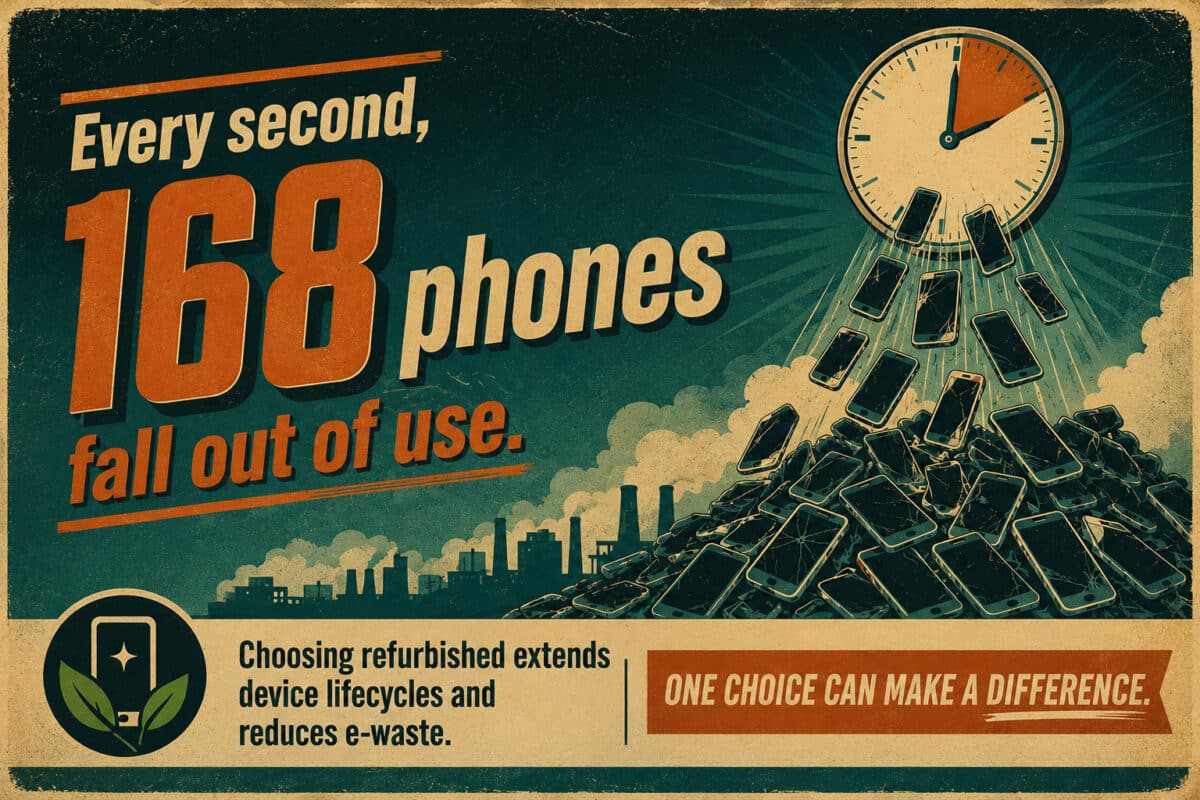
Here’s the stat that reframes everything: roughly 80% of a smartphone’s lifetime carbon emissions come from its manufacture — not from charging it every night for three years.
The mining of rare earth metals, the energy-intensive chip fabrication, the global supply chains — all of that happens before the phone reaches a shop shelf.
A single smartphone can generate somewhere between 55 and 95 kg of CO₂ equivalent during production, depending on the model.
By comparison, the day-to-day energy use of the phone itself is almost negligible.
This is why simply using your phone longer — or buying one that’s already been used — has a disproportionate environmental impact.
Extending device lifespans across the global market by just one year could avoid an estimated 21.4 million tonnes of CO₂ annually.
A refurbished phone avoids most of that manufacturing footprint entirely. Studies have put the carbon saving at up to 87% less CO₂ than buying new.
Refurbished Phones: The Most Direct Route Into Circular Tech
What “Refurbished” Actually Means
Refurbished doesn’t mean second-rate. A properly refurbished phone has been inspected, tested across core functions — display, battery, logic board, cameras, connectivity — and repaired or reconditioned where necessary. It’s graded, so you know what you’re getting, and it’s covered by a warranty.
- A phone sold person-to-person on a marketplace is untested.
- A refurbished phone from a reputable seller has been through a structured quality check. That’s the difference between a gamble and a grade.
For a full breakdown of how grading works and what to look for, our refurbished phone FAQ hub covers the most common questions buyers have before committing.
The Cost Argument Is Just as Strong as the Environmental One
Circular tech tends to get framed entirely around sustainability, but the financial case is equally compelling.
Refurbished flagships — phones like the iPhone 16 Pro or the Galaxy S24 — typically sell at a significant discount to their original retail price while delivering identical performance.
The hardware doesn’t change. The chip, the camera system, the display — all the same.
For buyers who want flagship performance without flagship pricing, refurbished is the practical answer, not a compromise.
Extending your personal device lifecycle from 24 to 36 months can reduce the carbon footprint of that device by around 40% and save you a meaningful amount of money at the same time.
What Components Actually Age — And What Doesn’t
The honest version of the durability conversation requires looking at specific components:
- Lithium-ion batteries degrade with charge cycles. A refurbished phone with significant battery wear is a legitimate concern — which is why reputable sellers report battery health and often replace cells below a threshold
- Flash storage (NAND) is highly durable and degrades very slowly under normal use; it’s rarely a meaningful issue in a refurbished handset
- Logic boards and SoCs don’t wear out in normal consumer use — a three-year-old Snapdragon or A-series chip performs identically to when it was new
- Displays can suffer burn-in on OLED panels over time, particularly on devices with static UI elements at high brightness; grade descriptions should flag this
The practical upshot: a refurbished phone’s main variable is battery condition, and that’s addressable. Everything else — the processor, the storage, the core hardware — is as capable as it was on day one.
The Circular Hierarchy: What to Do With a Phone at Each Stage
Buy Refurbished First
The highest-impact individual choice is buying refurbished rather than new. It keeps an existing device in the loop, avoids a new manufacturing cycle, and is typically cheaper.
Browse our current refurbished phone database to see what’s available across iPhone, Samsung, and Pixel.
Not sure which model makes sense for your needs? The Phone Finder tool lets you filter by budget, brand, and use case rather than guessing.
Keep It Longer
The current global average for smartphone replacement is around three years. Devices are technically capable of five to seven years of use with basic care.
Every year you extend a phone’s active life compounds the environmental saving from buying refurbished in the first place.
Software support matters here.
iPhones currently receive iOS updates for six or more years from launch — one of the strongest software longevity commitments in the industry, and a significant reason why pre-owned Apple handsets hold their practical value well.
Android varies considerably by manufacturer.
Trade In, Don’t Bin
When a device does reach the end of your use for it, it rarely reaches the end of its useful life. A phone that’s two generations old for you may be perfectly functional for someone else — particularly in markets where price sensitivity is higher.
Trade-in and take-back schemes route devices back into refurbishment pipelines rather than into landfill.
Currently, only around 17.4% of e-waste globally is properly recycled.
The rest is either stockpiled, informally recycled under poor conditions, or discarded.
Phones contain recoverable gold, silver, cobalt, and rare earth elements — materials that required significant extraction to obtain in the first place.
The Bigger Picture: Where Circular Tech Is Heading
Industry bodies including the GSMA have published frameworks positioning “maximised longevity” and “zero waste” as the target for mobile devices.
Right-to-repair legislation is gaining traction in the EU and, more gradually, in the US.
Manufacturers are facing increasing pressure to publish repairability scores and make spare parts available.
This isn’t a fringe movement. It’s where regulatory and consumer pressure is converging.
Buying refurbished now is ahead of that curve and increasingly, it’s where the best value sits too.
Devices worth considering at the premium end of the refurbished market right now include the iPhone 15 Pro Max for camera-focused users, the Galaxy Z Fold5 for productivity-heavy use, and the Pixel 9 Pro XL for Android users who want Google’s best with strong AI features.
Bottom Line?
Don’t get distracted by the sustainability framing if it doesn’t move you. The financial case for refurbished phones is self-contained.
You get the same hardware for less money and longer software support than most buyers realise.
The environmental benefit is real and significant, but it’s a bonus, not the reason you need to justify the choice. Buying refurbished is just a smarter way to buy a phone.
Explore our 680+ fully vetted refurbished phone database and see how much you could save today. Or, head to the Phone Finder if you want help narrowing it down by budget, brand, or use case.